


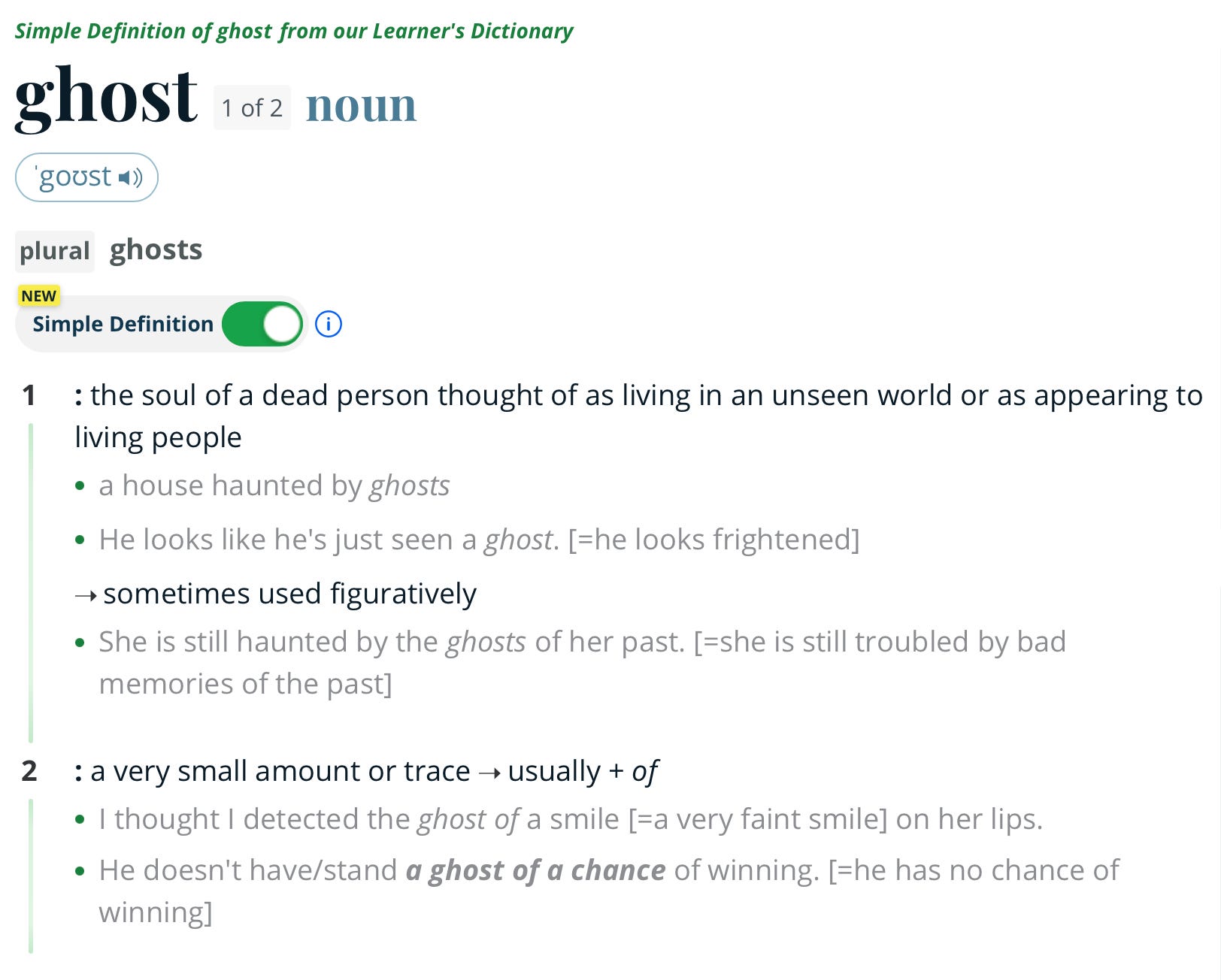
When I think of my family—parents, late brother, late sister—I think of ghosts. I’m mostly a skeptic, yet sometimes feel haunted by a small crowd of them. After all, I am my mother’s son, a product of the green shadows in the backwoods, the hills and hollows (hollers) of Middle Tennessee, of Appalachian lore handed down from her side of the family. As Mama would’ve said, they’s all kinds of haints out there.
Chilling as they can be, some ghost stories arise from self-soothing. We want to believe, if only for a moment, that no one is really gone.
The night my father died, I conjured one on the drive back to his house from the hospice facility.
Dad died just past one in the morning on August 21, 2023, twenty-three years and one day after my brother committed suicide. Swaddled in covers with pillows around his head and shoulders, my father, with his fine bones and heroic chin, looked like a forgotten king on his final throne, listing slightly to one side. Quiet, for once and for all.
In life, Dad rarely stopped talking. He was brilliant at it. Funny, offensive, sometimes startlingly insightful, sometimes churlish and self-pitying. It was hard to comprehend that the finely edged tenor bellow I could hear across the hills of our seven acres as a kid was now silenced forever. In a family of loud, chattering people, he was the loudest and chattered the most.
In that silence, looking at him, I couldn’t cry.
I know now it was shock. I’d also already wept off and on since I first arrived at the hospice and saw him there, thinner than he’d ever been, voice thready and weak. I didn’t want him to see me lose it, so I took myself out to the facility’s all-beige “Garden of Peace” and cried there on a bench adorned with a dead person’s name, hot sun beating down on my bald head until worrying I’d get burned sent me back inside, wiping my eyes.
I kissed his cold forehead and promised him I’d do my best to take care of my only living sister, shouldered my backpack, and left. The funeral home attendants would arrive later. They would place his body in a temporary casket on a gurney and drape it with a flag to honor his veteran status, roll him down that empty, too-bright hallway, out into the humid night, and drive the thirty-plus miles to where he would be cremated and interred in the days that followed.
I stood in the hospice facility parking lot. For a moment, I forgot where I parked the car. It was probably 2 am by then. The sky was clear, the Moon a bright silver clipping from a god’s fingernail. On the other side of a stand of ornamental trees, I thought I saw a few late-season fireflies sparking in the gloom. Then I realized I was just staring at that space instead of looking for the car.
I remembered the lights would flash if I hit the unlock button on the key. As I got in, a freight train sounded its horn a mile or so away, cutting through the woods and fields as it headed north to switch or unload in Nashville.
The train had no significance, yet the sound still comes back to me when I remember that night. Where I live in Massachusetts, I often hear the trains passing in the valley below when it rains, and they remind me, too.
It was 13 miles back to my parents’ house. I don’t remember what music I listened to.
To my folks’ dismay, I majored in music. It is still one of the few things that can fully engage me enough for a moment to not focus on something like the pain of seeing my vibrant, electric-minded father become a cold, waxen doll wrapped in sheets and propped up by pillows. Or the pain of remembering his last meal was horchata and Oreos. Or the pain of remembering wiping the black crumbs of cookie from the corners of his mouth after he’d fallen asleep again.
I turned off the empty interstate onto the empty parkway that led to the suburb where my parents had lived the final years of their lives: an innocuous warren of cheaply built, overly expensive McMansions with few trees, judiciously maintained lawns, and too many backyard pools. I turned off the parkway onto a connector road, passing the hospital where my sister died from sepsis seven years before. It looked monumental in the night, brown brick ornamented with amber accent lights.
Driving slowly, I sensed motion off to my right. A deer trotted down the sidewalk by the hospital. I braked to a stop, and the deer sped up and bounded across my headlights, a young buck, antlers still growing, stubby white tail perked. It seemed to sense my attention and, in a series of ever-growing leaps, it crossed the opposite lane and entered a dark, empty field across from the hospital. I lowered the driver’s side window and watched it go until the small white point of its tail vanished into the woods on the other side of the lot.
I sat there idling for a long time. No other cars came. I didn’t know how I felt then, but I somehow knew I was supposed to see that deer.
I had only been to the house briefly before going to the hospice, and at the time was too preoccupied to really pay attention to anything. Now the space felt like it was patiently waiting for Dad to return. The lamps were on in the dining room and living room, the warm ambient light he always preferred. A woman was singing in German, her voice echoing through the kitchen and back hall—his favorite singer in his second-favorite language to study (after Spanish). The last CD he’d listened to had been running on repeat from his old CD player ever since a friend drove him to the hospital after he’d begun finding blood where it shouldn’t be found.
I couldn’t stop the CD fast enough. My own music had comforted me in the car. But the singer’s voice in my parents’ now vastly empty home was as distressing as walking in on someone screaming in despair.
I couldn’t stop thinking about the deer.
A lot of people where I’m from might quote Psalm 42 when talking about deer and spirituality: “As the hart panteth after the water brooks, so panteth my soul after thee, O God.”
They might use it as a moment to proselytize. They might tell me it was a moment in which I was called to put my faith in God for comfort and care.
Dad would’ve thought that was bullshit. Not the mention of a deer in a spiritual context, just using a bible verse to plop another ass down in the pews. Growing up around all manner of holy rollers, he became an atheist, or agnostic in his questioning moments.
Deer figure heavily in other spiritual traditions, though, so humans have long seen them as a symbol of one kind or another. To the Lakota, it represents “guidance and challenge. The deer is seen as a being that tests perception and discipline. It reflects the idea that not everything is as it appears.”
Buddhists see deer as standing “among the symbols of long life — the crane, the tortoise, the conch, the tree, and the old man.” They represent a “long life not as a frozen thing but as a creature still free to leap… the deer as ‘life that hasn’t been caged.’”
Looking at my Ancestry.com DNA heritage results and this pale skin, green eyes, and red hair I inherited from Dad, I have no choice but to include the Celtic view of deer “as messengers between the physical and spiritual worlds. The stag, in particular, symbolizes leadership and the journey to self-discovery.”
The deer I saw that night was just trying to stay alive. Maybe it was looking for water, food, or a chance to mate. It was just a deer, doing its thing in the world. I was a man as alone as I’d been in a long, long time, looking for meaning. Seeking a reassuring word from my ghosts, in some form.
The deer was real, but I’d made it a mount for another ghost. I hoped it might haunt me for a bit, to reassure me he wasn’t entirely gone. A haunting I would welcome, at least for a while. Or maybe, since I could tell it was young, I thought the deer was another of my ghosts—my brother, perhaps—reassuring me that Dad was out of pain now and somewhere, somehow, somewhen, talking again. There, the room was lit just right and loud; others, like my grandmother or my sister, were talking over him. Everyone was drinking coffee and enjoying the sound of their own voices, and beneath it all, loving being together.
My family was so talkative; I used to dislike the quiet.
I’ve grown more comfortable with it since so many of them have passed. Now, sometimes, I listen closely in silence, searching for the distant chatter of my beloved ghosts.